Showing posts with label Eagle. Show all posts

Monday, December 27, 2010

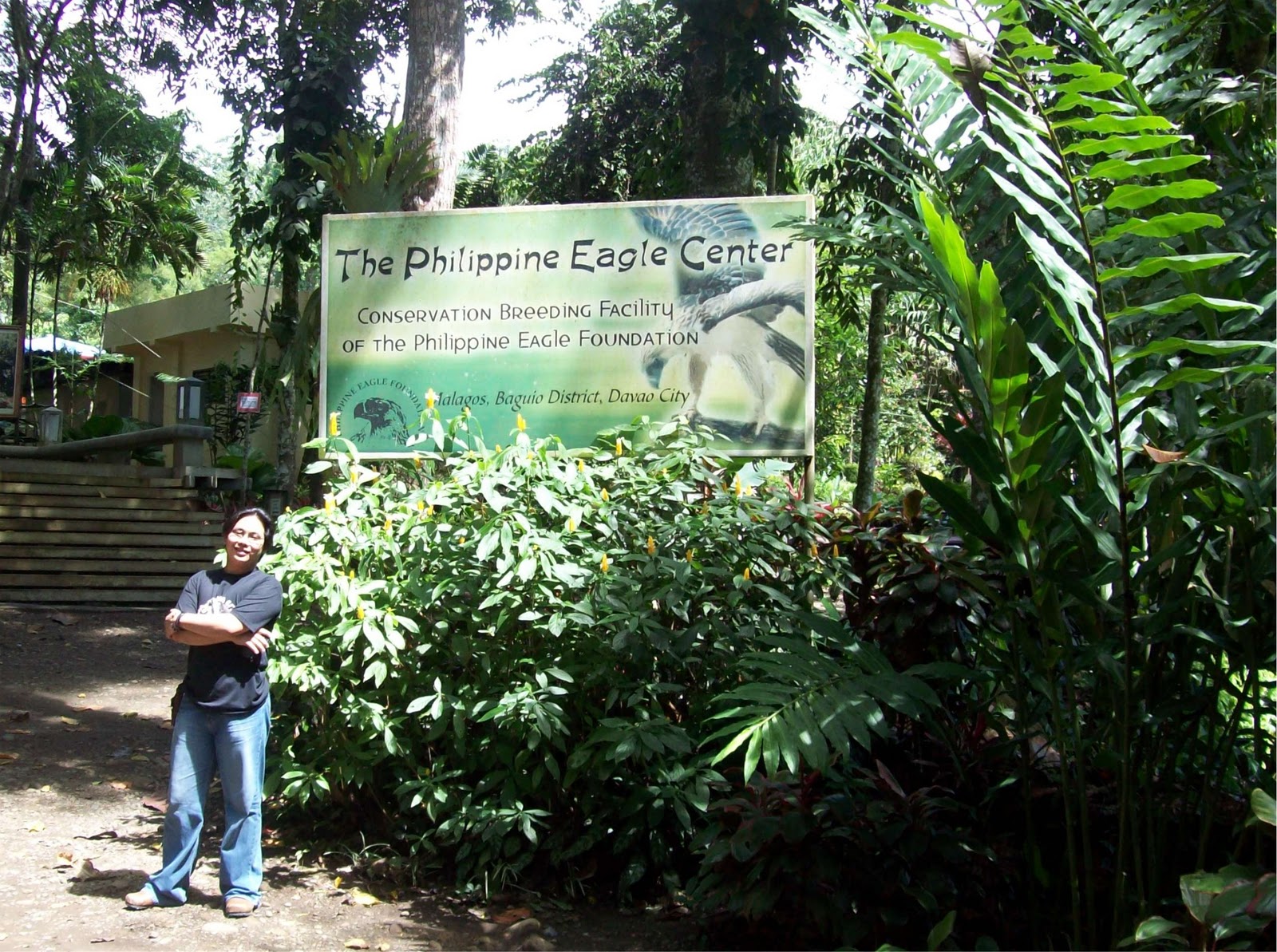
Philippine Eagle Center: Home To World's Noblest Flier

“For me, the highlight of my Davao trip was a visit to the Philippine Eagle Center,” wrote a Cebuano journalist after he returned home.  “The drive, although a bit far, was worth it after seeing the majestic creature.”

Visitors, both foreigners and locals, who come to Davao City for the first time, are almost always attracted to the Philippine Eagle Center in Malagos, Calinan.  Some 30 kilometers northwest and about an hour’s ride from downtown Davao, the center is the transient home of the Philippine eagle.

Here, visitors can see more than a dozen eagles, some of which were rescued after they were trapped or shot. Thirty-two birds have been raised as part of a breeding program.  Most of them are being induced to breed in captivity.  Pag-asa is one of its noted attractions; it made the headline around the world as the first tropical eagle conceived through artificial insemination.  Pag-asa is the Tagalog word for “hope.”

“Pag-asa connotes hope for the continued survival of the Philippine eagle, hope that if people get together for the cause of the eagle, it shall not be doomed to die,” said Dennis Salvador, the executive director of Philippine Eagle Foundation (PEF).

PEF manages the eagle center.  A private, non-stock organization, it is dedicated to saving the endangered bird.  “By using the Philippine eagle as the focal point of conservation, we are, in the process, saving wildlife and their habitat,” said Salvador. 

The Philippines is among the world’s seventeen “megadiversity” countries, which together account for some 60-70 of total global biodiversity.  The World Conservation Union has identified the country as one of the most endangered of the world’s biodiversity “hotspots” – threatened areas with very high levels of biodiversity.

The Philippine eagle is one of the most endangered species in the country.  According to Salvador, the reason for this was due to massive deforestation.  “Deforestation is terrible,” he pointed out.  “The Philippine eagle has become a critically endangered species because the loss of the forest had made it lose its natural habitat.”

PEF aims someday to release the captive birds and those that have been artificially bred back into its natural habitat.  But “if time will come that we have enough stocks, where shall we release them” Salvador wondered. 

The Netherland ambassador to the Philippines Robert G. Brinks echoed the same sentiment.  “If nothing drastic is done about deforestation of the remaining woodland areas in Mindanao, within the lifetime of the present generation, the heritage of the national bird of the Philippines will only be seen on DVD, or at best tethered to a stump of a dead tree in the Eagle Center in Davao,” he deplored.

Efforts to save the Philippine eagle was started way back 1965 by Jesus A. Alvarez, then director of the autonomous Parks and Wildlife Office, and Dioscoro S. Rabor, another founding father of Philippine conservation efforts.

Rabor fought for the recognition of the plight of the Philippine eagle at the world conference of the International Union for the Conservation of Nature and Natural Resources (IUCN) in Bangkok, Thailand. He succeeded when the IUCN – of which the Philippines is a signatory -- was declared the Philippine eagle an endangered species.

From 1969 to 1972, America's famed aviator Charles Lindbergh spearheaded a drive to save the bird, which he called as the “noblest flier.” Within this time frame, several helpful laws were passed.

During the time of the presidency of Fidel V. Ramos, he declared the bird – which is bigger than the American Bald eagle – as the national bird.  This brought the bird to the top of the priority list of Philippine wildlife conservation efforts.  If the national bird dies, so will all the country’s efforts at conserving its natural resources and treasures, Ramos said at that time.

The eagle center has been doing its best to educate the Filipino people as to the importance of the bird and its habitat.  Its facility was actually opened to the public in 1988 to raise awareness among those who visit the center.  Majority of its visitors are children on school-sponsored field trips.

“Many of these children came from all over Mindanao,” Salvador said.  “We use the opportunity in telling them the importance of wildlife conservation.  Our mode of dissemination ranges from providing lectures, slide and film presentations, to guide tours.” 

Many Filipinos – and some foreigners – were baffled: Why do we have an endangered Philippine eagle as the country’s bird icon? 

The Philippine eagle was formerly known as monkey-eating eagle (its generic name, Pithecophaga, comes from the Greek words pithekos or monkey and phagein meaning eater).  It was later renamed the Philippine eagle by Presidential Decree No. 1732 in 1978 after it was learned that monkeys comprise an insignificant portion of its diet, which consists mainly of flying lemurs, civet cats, bats, rodents, and snakes.

The eagle stands a meter high, weighs anything from four to seven kilograms and has a grip three times the strength of the strongest man on earth.  With a wing span of nearly seven feet and a top speed at 80 kilometers per hour, it can carry unsuspecting monkey and carry it off without breaking flight.

Unlike most animals and humans, Philippine eagles are monogamous and bond for life.  Once an eagle reaches sexual maturity – at around five years for females and seven years for males – it is bound for life with its mate.  They can be seen soaring in pairs in the skies.

The female eagle lays once every two years.  The breeding season ranges as early as July to as late as February.  During the breeding season, the eagles do aerial courtship and mate in the nest or near it.  Female eagle lays only one egg.  Both parents alternately incubate the egg for about 60 days, although the female spends more time incubating while the male hunts.

Upon hatching, the eaglet remains in the nest for about five and half months.  Once it fledges, the eagle parents will continue to look after its young for as long as 17 to 18 months teaching the young eagle how to fly, hunt, and to survive on its own.  The young eagle matures in about six years.

“The Philippine eagle is truly a Filipino pride,” said my nephew, Generoso Tacio, Jr.  After our tour, he added, “Now, I know why we have to protect and save them from disappearance in our land.”

 Aside from Philippine eagles, you can also see these birds at the center: black-and-cinnamon fantail, black-faced coucal, blue-crowned racquet-tail, brown tit-babbler, brush cuckoo, chestnut munia, cinnamon ibon, dark-eared brown-dove, eurasian tree sparrow, everett’s white-eye, glossy swiftlet, golden-bellied fly-eater, little spiderhunter, olive-backed sunbird, orange-bellied flowerpecker, rufous night-heron, silvery kingfisher, and stripe-breasted rhabdornis. -- ###



Saturday, December 18, 2010

Davao City: The Gateway to Mindanao


From islands to highlands – that’s what awaits anyone who comes to Davao City. The center of trade and commerce in Mindanao, it is also the hub of tourist attractions and activities. Its typhoon-free weather, warm and hospitable people, and mouth-watering foods make Davao the perfect holiday spot for the entire family.

Davao is one of the world’s largest cities in terms of land area, occupying more than 2,400 square kilometers. It has a resident population of 1.3 million, who speak mostly Bisaya (the national language comes second). English is the medium of instruction in schools and is widely understood and spoken especially in the business community.

Davao is known for its three icons: durian, waling-waling, and Philippine eagle. Controversial durian, which “smells like hell but tastes like heaven,” abounds almost all-year round throughout the city. Endangered waling-waling can be viewed at Malagos Garden Resort in Calinan district (some 45 minutes ride from the heart of the city). Going up further, about five minutes, you can get a glimpse of the country’s national bird at the Philippine Eagle Center.

What are the other things you see while in Davao? If history is your thing, there’s the Battle Memorial, a historical marker of the longest-fought battle between the troops of the American and Filipino forces and of the Japanese Imperial Army which took place in Mintal, Tugbok.

In Calinan, there is a museum that features historical accounts of the Japanese community residing in Davao before and during the war. You can see various artifacts, including tools which they used in the abaca plantations, currencies, and publications.

Along San Pedro Street, you can visit Camp Domingo Leonor, which happened to be the quarters of the Spanish and later American soldiers in the 1920s. At the junction of Washington Street and Quimpo Boulevard, you can get a glimpse of site of the bastion of the Muslim hero Datu Bago who lorded over the Tagloc River (the old name of Davao River). At the Talomo Beach, you will see sunken warships during the Second World War, just 200 meters from the shore.

For those who are interested in anything related to Catholic religion, they should go first to the San Pedro Cathedral, one of the oldest churches in Mindanao. The original structure of the church was built in 1847 in honor of St. Peter, the city’s patron saint. The old altar is preserved at the right wing of the cathedral.

At the Shrine Hill in Matina, there’s the Shrine of the Holy Infant Jesus of Prague, a local mecca of the city’s Roman Catholic devotees. At the Buhangin District, you can say your prayer at the Saint Mary of Perpetual Rosary. This is a shrine built in honor of the Blessed Virgin Mary which features series of steps which leads to the main chapel.

Not far from the eagle center is Malagos Garden Resort, which hosts a rich collection of rare indigenous Philippine flora and wide assortment of orchids. Several species of butterflies also thrive in its enclosed sanctuary. Within its area, a bird park has been built to shelter rescued and rehabilitated birds.

Another must-see is the Eden Nature Park, a popular mountain resort. It is situated 3,000 feet above sea level, giving it a cool and moderate climate. It is 95% man-made with pine trees dotting the landscape. It covers 40 hectares worth of developed land.

In addition, try to visit the Davao Crocodile Park at Ma-a diversion road (about 20 minutes from the heart of the city). “The park is an establishment that showcases a state-of-the-art crocodile farming system in the Philippines,” owner Philip ‘Sonny’ Dizon. “It has the most recent crocodile farm design equipped with modern facilities and equipment.”

Actually, the park is more than just a crocodile farm (it has about 700 of them!); it also houses other kinds of animals like wild cats, python, marine turtles, monitor lizard, Philippine deer, monkeys, and various kinds of birds (including ostrich and eagles).

At the heart of the city, People’s Park is fast becoming the often-visited place. Opened in 2007, the P72-million park features many delightful treats for its beholders to discover. Grand landscaped waterfall, strategically scenic benches, a small but fun playground, amazingly breathtaking gardens, arranged multipurpose trees, lovely traditional cottages and sophisticated sculptures created by Kublai Milan (the Dabawenyo artist who created the Freedom statue in front of the Sangguniang Panlungsod building).

Davao also has a number of beaches to offer. Times Beach, two kilometers from the city center, bustles with picnickers during Sundays and holidays. Historic Talomo Beach is best remembered as a landing site for Japanese and American forces during World War II.

Across the strait due east from the mainland is Samal, an unspoiled island ringed with secluded coves of white sand. Five minutes away via pumpboat from barangay Vicente Hizon is the world-class Bluejaz Beach Resort and Waterpark. Known as a famous hotspot for extreme activities such as water slides, wakeboarding, and zipline, it offers guests a very tranquil, relaxing, and enjoyable stay.

For a first class accommodation, try the Pearl Farm Beach Resort. Nestled in a secluded cove some 45 minutes by motor launch off the coast of Davao, it is one of the country’s most up market beach resorts. “This exquisite place in Davao Philippines is what you call paradise on earth,” hailed former tourism secretary Joseph “Ace” Durano.

Fruits are always ripe for the picking in the “fruit basket of the Philippines.” Whether you’ll go for the juiciest watermelon, the sweetest mango, the more succulent pomelo, rambutan, or go subtly fruit ferocious with banana, mangosteen, lanzones, pineapple, avocado, jackfruit, buko, or simply settle with a bowl of fresh fruit salad to end the long list, whatever fibrous or juicy fruits you have in mind, you’ll definitely have your fill in the city. Buy them fresh at the fruit stands in Madrazo, a five-minute walk from Marco Polo Hotel.

If you can’t eat durian fresh, you can drink it as durian cappuccino. Only Blugré Café serves this unique brew of durian and coffee. Other places to visit for coffeeholics are Jose Rafael Fine Coffee, Caffé Firenzo, Roadhouse Café, Prego Café, Kopi Roti, Kasagingan Kapehan, Fagioli Coffee Club, and Basti’s Brew.

Visitors would never go hungry because different grill restaurants are all over the city. To name a few: Hanoi Vietnamese Cuisine in Camus Street; Harana, Mongolian Garden Restaurant, and Sarung Banggi in F. Torres Street; Picobello Ristorante Italiano at the 5 th level in Ilustre’s Gaisano South Citimall; and Swiss Deli and Restaurant and Tsuru Japanese Restaurant and Sushi Bar, both in Lanang.

Davao is known for its inihaw (grilled tuna) and kinilaw (local version of sashimi using tuna or blue marlin strips). These are served in almost all restaurants and even in eateries inside the malls.

Davao City is very accessible. It has regular air, sea, and land linkages to major points in the country. Davao City International Airport serves several flights everyday for passengers coming from and going to Manila (about one hour and 35 minutes away). There are four times weekly flights to Singapore and twice weekly flights to Indonesia (Manado).

Maayong pag-abot!


Twitter Delicious Facebook Digg Stumbleupon Favorites More

 
Powered by Blogger | Blogger Templates | Business Credit Cards